Let's start with the number you came for. The IVF cost in Mexico is about $6,000 to $12,000 USD (MXN 113,000 to 226,000) for a full cycle with medications and add-ons, against $11,000 to $23,000 USD or more in the US. Quotes near $4,000 USD usually leave things out.
These numbers come from 2026 figures published by OVU and Fertility Clinics Abroad next to FertilityIQ's US cost data, converted at Banxico's rate of October 30, 2026. And since insurance rarely covers IVF in the US, most of that bill usually lands on you.
If you're reading this, chances are the price is only one of the things on your mind, and that's normal. Infertility affects about one in six people worldwide, according to the World Health Organization, so you're far from alone.
And if US quotes have put treatment out of reach, is it fair to look abroad? Absolutely, whether you're deciding on your own or with a partner. We'll cover prices, extras, travel, safety and aftercare, so you can decide with confidence.
A high-complexity laboratory and a quote near $4,000 USD aren't the same thing, and once you see why, you can compare IVF in Mexico with a US clinic on equal terms, line by line.
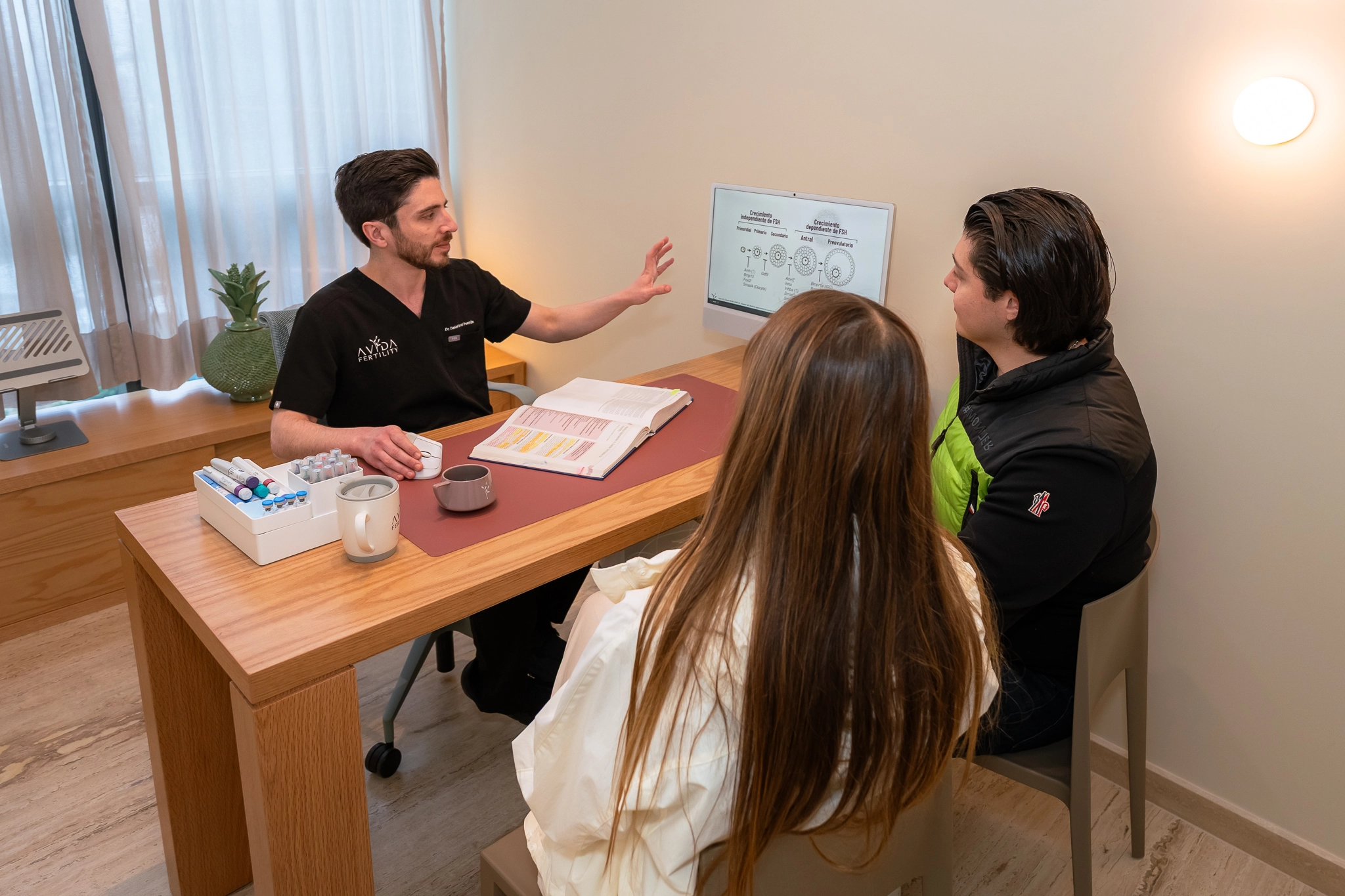
Take charge of your fertility with experts.
Your body is one of a kind, and so is your treatment. Rely on a highly specialized medical team that explains your options with full transparency, backing every decision with precision technology and genuine, human support from day one.
How Much Does IVF Cost in Mexico Compared With the US?
Short answer: a complete cycle in Mexico usually lands between $6,000 and $12,000 USD, compared with $11,000 to $23,000 USD or more in the US. The gap looks bigger on paper than in real life, so let's split the price into three layers:
Layer one is the advertised base cycle, about $4,000 to $8,200 USD (MXN 75,000 to 154,000). It usually covers monitoring, egg retrieval, lab work and one transfer, but often not your medications.
Layer two is the medications: the injectable hormones you take for eight to 14 days so your ovaries can produce eggs. They add $1,500 to $3,500 USD (MXN 28,000 to 66,000).
Layer three is the complete cycle, which adds the standard extras. Think of ICSI (a technique that places one sperm directly into an egg), anesthesia and a first embryo freeze.
Once you see the three layers, you may be asking yourself how much does in vitro fertilization cost in Mexico? Honestly, the number to remember is the complete-cycle range, about $6,000 to $12,000 USD, because that's the price with your medications and standard add-ons included.
Every clinic decides what goes into its base price, so the IVF treatment cost in Mexico can look very different from one quote to the next. That's why a cost breakdown, with a price range for each layer, a date and a source, tells you more than one single figure.
On the US side, FertilityIQ's cost data lists medical fees of $8,000 to $14,000 USD and medications of $3,000 to $7,000 USD, and the average comes to about $23,474 USD per cycle.
Avida's 2026 market reference puts a cycle with medications at a high-complexity Mexican clinic at MXN 145,000 to 255,000 (about $7,700 to $13,600 USD). This is not a quote. For the other parts of treatment, see our component-by-component price ranges.
Directories such as OVU advertise savings of 50% to 70%. Our own arithmetic gives a more modest picture: about 35% to 60% less for a complete cycle in Mexico, depending on which US benchmark you pick.
The $9,000 USD midpoint of the Mexican range sits 44% below a $16,000 USD US midpoint (base fees plus medications) and 62% below FertilityIQ's $23,474 USD average. So will you always save that much? Only when the quotes, and the laboratories behind them, are truly comparable.
Prices as of October 30, 2026. MXN amounts use Banxico's published FIX rate of 18.7962 per US dollar on that date. Rates move, so check again the day you book.
Prices mentioned are referential and may vary based on your specific case. Request a personalized quote during your consultation. These are market ranges, not Avida Fertility quotes.
Why Is the Cost of IVF in Mexico Lower, and Is the Gap Always That Big?
Lower operating costs help explain why the cost of IVF in Mexico is lower than in the US, though the gap isn't always as big as it looks. How wide it is depends on what each quote includes and which laboratory stands behind it.
Where the difference comes from. OVU points to lower rent, salaries, insurance and malpractice premiums, plus less billing overhead. In the US, most patients pay for IVF out of pocket, and FertilityIQ's numbers above show how fast fees and medications add up.
When the gap shrinks. Here are three situations where the difference gets smaller:
- A Mexican quote leaves out medications, ICSI or anesthesia, so you end up paying for them later.
- The stay is long, or you travel twice, so flights and lodging add to the total.
- A high-complexity laboratory is priced near the low end of US ranges: Avida's own market reference tops out near $13,600 USD, against a US floor of about $11,000 USD.
Clinics aren't priced alike. In the market reference on Avida's pricing page, high-complexity programs usually include ICSI, monitoring and freezing in the base price, while standard-clinic quotes often list them as extras. So what does a fair comparison look like?
It's a high-complexity Mexican cycle against a typical US cycle, not the lowest advertised Mexican number against the US average. Since lower prices reflect cost structure, ask every clinic to show you its oversight, outcomes and follow-up plan.
What Should IVF Packages in Mexico Include?
A good quote spells out egg retrieval, lab work and at least one embryo transfer, and a few items are usually priced on their own. When you compare IVF packages in Mexico, knowing what's bundled and what's extra is your best protection against surprises.
Let's start with what a complete quote lists, then look at the extras.
What does a complete IVF package in Mexico usually include?
A complete quote lists consultation and testing, monitoring, retrieval, fertilization, culture, at least one transfer and first-year storage. Here's what to look for in writing:
- Consultation and baseline testing, such as AMH (a blood test that estimates your ovarian reserve, meaning how many eggs you have left), FSH (a hormone that helps eggs grow) and an antral follicle count (an ultrasound count of resting follicles).
- Ultrasound and blood monitoring while your ovaries are stimulated.
- Egg retrieval with anesthesia or sedation.
- Laboratory fertilization, with ICSI when it's indicated.
- Embryo culture to the blastocyst stage (an embryo grown for five or six days).
- At least one embryo transfer.
- Freezing and first-year storage of any extra embryos.
Many programs freeze all embryos and transfer later. Ask whether your first transfer will be fresh or frozen, because that changes your timeline.
What is often billed separately in an IVF package?
Medications are the item most often billed on their own, and FertilityIQ lists them apart from the base fee too. A few other things commonly show up as optional extras:
- ICSI, often recommended when there's a male-factor concern or earlier fertilization problems.
- PGT-A (genetic testing that screens embryos for chromosome differences), usually priced per batch of embryos.
- Anesthesia and blastocyst culture.
- Additional transfers and annual storage.
- Doctor, hospital or coordinator fees.
What questions should you ask before you pay for IVF in Mexico?
Before you pay, ask for the quote in writing and go through these eight questions with whoever is quoting you. You deserve a clear answer to each one:
- Is this a base price or an all-in total for my case?
- Are medications, anesthesia and ICSI included?
- How many transfers are included, and what do extra ones cost?
- What are the storage fees after the first year?
- What happens if the cycle is canceled or no embryos form?
- Who is my treating physician, and who monitors me at home?
- In what currency, on what payment schedule and with what refund or multi-cycle program terms?
- Can I have the quote itemized in writing?
You can also do some starting tests near home, such as fertility testing in Mexico, before you travel.
Is IVF in Mexico Safe for Americans?
Safety is a fair place to start. Is IVF in Mexico safe? It can be, at licensed clinics, because most medical risks are the same as at home.
What changes abroad is how easily you can check oversight, outcomes and follow-up. Let's start with who oversees clinics, then the risks, and finally your plan for care at home.
What oversight exists for IVF clinics in Mexico?
COFEPRIS, Mexico's federal health regulator, plays a role similar to the FDA. Clinics operate under sanitary permits, and you can ask any of them for the permit number in writing. Avida's COFEPRIS permit is 253300201A1949.
Doctors in Mexico hold a professional license called a cédula profesional, issued by the Secretaría de Educación Pública (SEP). Ask for your doctor's license number and training in reproductive medicine, and you're welcome to meet our medical team before you decide.
Mexico has no national law specific to assisted reproduction, according to a peer-reviewed 2021 review. Fertility Clinics Abroad adds that clinic success rates can be hard to find. That puts more of the checking in your hands, so ask for the permit number, license number and age-specific outcomes in writing.
Which IVF risks do not depend on the country?
The main medical risks of IVF are the same wherever you have treatment. The American Society for Reproductive Medicine (ASRM) lists ovarian hyperstimulation syndrome (OHSS, when the ovaries react strongly to fertility medications) and multiple pregnancy when more than one embryo is transferred.
ASRM also lists less common procedure risks: pelvic infection after egg retrieval or embryo transfer, injury to nearby organs such as the bladder, bowel or blood vessels, and ectopic pregnancy (a pregnancy outside the uterus), at about 1%.
The reassuring part: about one in three people have mild OHSS symptoms during stimulation, and ASRM's OHSS fact sheet notes that hospitalization is rarely needed. In severe cases, blood clots and kidney failure can occur, but only very rarely, in less than 1% of IVF cases.
How do you plan for care after you fly home from IVF in Mexico?
Please agree on a plan for care at home before you travel. After all, what if something feels off once you're back?
CDC guidance on medical tourism notes that licensing, credentialing and accreditation requirements may be less strict in some countries. It suggests bringing home copies of your medical records, confirming follow-up care in the United States, and carrying travel health insurance that covers medical evacuation.
Talk to your US doctor before you go, and agree on which local OB/GYN or fertility specialist will see you if you feel unwell.
Then keep these warning signs from ASRM's OHSS list in mind, and reach out quickly if you notice any of them:
- Difficulty breathing.
- Continued vomiting or nausea.
- Difficulty tolerating fluids.
- Abdominal swelling or sudden abdominal pain.
- Decreased urination.
- Weight gain of more than three pounds in two days.
- Swelling or redness in the legs.
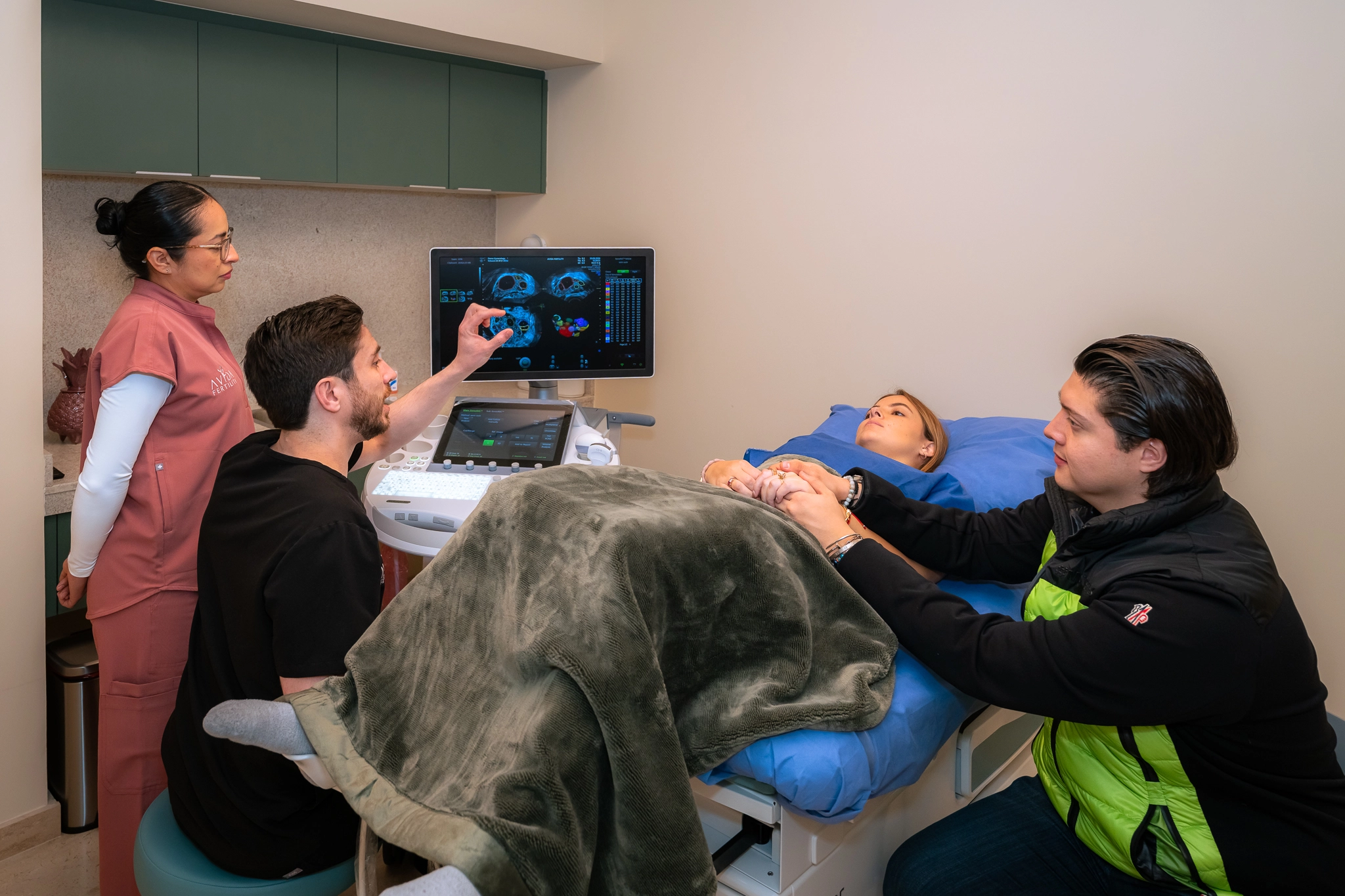
Care that starts by listening to you.
We know every story is different and that taking the first step takes courage. Our medical team takes the time to assess your overall health and walk you through your options step by step, in a safe space and with complete transparency.
How Long Do You Need to Stay in Mexico for IVF, and Does Travel Change the Cost?
Plan on roughly two to three weeks for a full cycle at the clinic, and less if early monitoring happens near home. Does travel change the cost? Let's look at the stay first, then paperwork and flights, and finally the break-even math.
How long is the stay for each type of IVF cycle?
For a full fresh cycle with all monitoring at the clinic, plan on about two to three weeks. That answers how long you need to stay in Mexico for IVF, and it matters as much as price because it decides how much time off work you need.
If your early monitoring happens near home, OVU puts the stay at eight to 12 days around retrieval.
Here are the three trip types:
Your exact dates depend on the clinic's protocol and how your body responds, so treat these as planning ranges. A frozen embryo transfer, which uses embryos frozen from an earlier retrieval, is the shortest trip, from a few days to about a week.
At Avida you can go home the same day after egg retrieval, which shortens the hotel stay around that step. Planning IVF in Mexico around work and family gets easier once you know your dates, so ask for a day-by-day schedule early.
What entry rules and flights should you plan for IVF in Mexico?
US citizens need a valid passport and an FMM (Multiple Migratory Form) tourist permit, but no visa.
The Mexican consulate says US citizens can enter for tourism, transit or business without a visa for up to 180 days, and the FMM states the stay you're authorized.
Most major US hubs have nonstop flights to Mexico City, taking about 3.5 to six hours.
Mexico City is on UTC-6 all year, with no daylight saving time since 2022, the same as US Central Standard Time.
Is IVF in Mexico still less expensive after flights and lodging?
Mexico stays less expensive as long as flights, lodging and time off work cost less than the price gap. But will the trip eat up your savings? Here's an easy way to check:
gap = US cost minus Mexico cost; trip cost = flights (for every trip) + nights times lodging + meals and local transport + lost wages
Here's an example using only the figures above. FertilityIQ's average of $23,474 USD against Avida's Mexico market reference of $7,700 to $13,600 USD leaves a gap of about $9,900 to $15,800 USD.
Using the lower US midpoint of $16,000 USD (base fees plus medications), the gap is about $2,400 to $8,300 USD. A hotel-and-flight bill of a few thousand dollars usually fits inside the first gap and can use up part of the second.
How Does IVF in Mexico Work for US Patients, Step by Step?
Most of the planning happens from home, and you only travel for the procedures. So what does that look like in practice? Here's how it usually goes:
- Start with a video consultation. Share your prior results (AMH, FSH, antral follicle count and a semen analysis, if one applies), and bring your questions, whether you come on your own or with a partner.
- Complete your work-up and get an itemized plan. Tests can often be done near home and shared digitally, so plan on one to two weeks.
- Plan the trip around your cycle. Your dates come from the clinic. Then you can book flights and lodging, and run the break-even check above.
- Treatment in Mexico City. Monitoring, retrieval, the embryology laboratory and transfer all happen at a fertility clinic in Mexico City, in Avida's case in Interlomas, Huixquilucan.
- Hand off to your US doctor. Your pregnancy blood test (beta-hCG, the hormone that signals a pregnancy) comes 10 to 12 days after transfer, and your US doctor can run it. Ask for your treatment summary and records in English.
How Do You Compare IVF Success Rates and Quotes From Clinics in Mexico?
Success rates can be hard to find for clinics in Mexico, so any number you do see needs some context. A few simple definitions will help you judge most claims.
Let's start with how to read the numbers, then what to ask each clinic to put in writing.
How do you read IVF success rates?
Start by asking for live birth rates by age, per embryo transfer or per retrieval, and be careful with numbers that look too good to be true.
Clinical pregnancy means a pregnancy confirmed on ultrasound, while live birth means a baby was born. That second number is the one that matters most to you.
The denominator, meaning what the percentage is measured against, matters just as much. A rate per transfer counts only the transfers that happened. So what about the cycles that never reached transfer?
A rate per retrieval counts them too, because it includes every egg retrieval started, even those that ended without a transfer. A cumulative rate adds several cycles together, so it will always look higher.
If you see percentages far above national figures, they may reflect cumulative results, younger patient groups, donor-egg cycles or an unstated denominator.
For a US benchmark by age, Avida's page on success rates cites CDC data from 2022. It lists live births per cycle with the patient's own eggs: 49.7% under 35, 36.3% at 35 to 37, 23.1% at 38 to 40 and 7.7% over 40. Those are reference figures, not Avida's own rates.
What should you ask an IVF clinic in Mexico to put in writing?
Here are four things to ask for, because each one connects directly to what you'll pay:
- The itemized quote, using the checklist above.
- The age-specific outcomes behind any success claim, and what they are measured against.
- Who the treating physician is, and whether your appointments and records will be in English.
- What happens after you fly home, and who you call.
How Does the IVF Cost in Mexico Compare With Other Countries and Mexican Cities?
Some countries list lower sticker prices than Mexico, but distance, entry rules and follow-up care change the final total. The table below shows the own-eggs IVF ranges that Fertility Clinics Abroad lists, which usually leave out medications, travel and lodging:
Euro prices are converted at the European Central Bank reference rate of 1.1172 USD per euro on October 30, 2026.
Border and resort cities such as Tijuana and Cancun, and cities such as Guadalajara, often advertise the lowest headline prices.
In most cases the price differences come from package scope and laboratory level rather than from the city itself, so compare what's in the quote, not the postcode.
Can Single Parents and LGBTQ+ Families Do IVF in Mexico?
It can be possible, but eligibility is set clinic by clinic. Mexico has no national law specific to assisted reproduction, and Fertility Clinics Abroad says Mexico welcomes international patients regardless of their age, sexual orientation or marital status.
Every family deserves a straight answer here, so before you pay for anything, ask each clinic how it works with your situation.
Reciprocal IVF, also called the ROPA method, lets one partner provide the eggs while the other carries the pregnancy. Because two people are treated, it costs more than standard IVF, so ask for a written quote that covers both partners' treatment.
If you're becoming a parent on your own, Avida describes treatment plans for single mother by choice and single father by choice paths. Trans and non-binary parents can ask the same questions.
Your consultation is the place to confirm what applies to you and your partner, if you have one.
Do You Need IVF Right Now, and When Should You Talk to a Fertility Specialist?
Not everyone needs IVF first, and a simple evaluation is the best way to find out what fits you. ASRM suggests seeking an evaluation after 12 months of trying if the person with ovaries is under 35, and after six months if they are 35 or older.
You may want to go sooner if you have a family history of early menopause, a history of cancer treatment in either partner, irregular menstrual cycles, a risk of fallopian tube damage, childhood problems with the testicles or difficulty with sexual function.
Not sure whether any of this applies to you? That's okay, and an evaluation can sort it out.
For some people, intrauterine insemination (IUI), a simple procedure that places prepared sperm directly in the uterus around ovulation, is a reasonable first step.
If you'd like to see your options side by side, you can browse the full range of fertility treatments in Mexico and compare fertility treatment prices in Mexico.
Take charge of your fertility with experts.
Your body is one of a kind, and so is your treatment. Rely on a highly specialized medical team that explains your options with full transparency, backing every decision with precision technology and genuine, human support from day one.
In Summary
A complete IVF cycle in Mexico is about $6,000 to $12,000 USD, against $11,000 to $23,000 USD or more in the US, once medications and standard add-ons are counted. Our arithmetic puts the savings at about 35% to 60%, and they depend on the laboratory behind each quote.
Run the break-even check with real flight and lodging quotes. Not sure what to ask for? Start with the COFEPRIS permit number, the physician's license number, an itemized quote and age-specific outcomes in writing, and agree on who will care for you after you fly home.
You don't have to work through all of this alone.
Book your assessment
References
- World Health Organization. 1 in 6 people globally are affected by infertility. News release, 4 April 2023. https://www.who.int/en/news/item/04-04-2023-1-in-6-people-globally-affected-by-infertility
- OVU. IVF in Mexico 2026: medical tourism costs and fertility clinic guide. https://ovu.com/fertility-insights/ivf-in-mexico-2026-medical-tourism-costs-fertility-clinic-guide
- Fertility Clinics Abroad. IVF in Mexico 2026: costs, egg donation and is it safe? https://www.fertilityclinicsabroad.com/ivf-abroad/ivf-mexico/
- Carrot Fertility. How much does IVF cost in the U.S.? (FertilityIQ cost data). April 20, 2026. https://web.get-carrot.com/blog/ivf-cost-understanding-the-expenses-of-in-vitro-fertilization
- Banco de México. FIX exchange rate, USD/MXN, October 30, 2026: 18.7962. https://www.banxico.org.mx/tipcamb/tipCamMIAction.do?idioma=en
- European Central Bank. Euro foreign exchange reference rate, US dollar, October 30, 2026: 1.1172. https://www.ecb.europa.eu/stats/policy_and_exchange_rates/euro_reference_exchange_rates/html/eurofxref-graph-usd.en.html
- López A, Betancourt M, Casas E, Retana-Márquez S, Juárez-Rojas L, Casillas F. The need for regulation in the practice of human assisted reproduction in Mexico. An overview of the regulations in the rest of the world. Reprod Health. 2021;18:241. https://pmc.ncbi.nlm.nih.gov/articles/PMC8627078
- American Society for Reproductive Medicine. In vitro fertilization (IVF): what are the risks? https://www.reproductivefacts.org/news-and-publications/fact-sheets-and-infographics/in-vitro-fertilization-ivf-what-are-the-risks/
- American Society for Reproductive Medicine. Ovarian hyperstimulation syndrome (OHSS). https://www.reproductivefacts.org/news-and-publications/fact-sheets-and-infographics/ovarian-hyperstimulation-syndrome-ohss/
- American Society for Reproductive Medicine. Defining infertility. https://www.reproductivefacts.org/news-and-publications/fact-sheets-and-infographics/defining-infertility/
- Centers for Disease Control and Prevention, Travelers' Health. Medical tourism. https://wwwnc.cdc.gov/travel/page/medical-tourism
- Consulado de México (SRE). Visas: citizens and permanent residents of the US and Canada. https://consulmex.sre.gob.mx/presidio/index.php/visas/30-visas/142-visa-en
- Internal Revenue Service. Publication 502, Medical and Dental Expenses. https://www.irs.gov/publications/p502
- Comisión Federal para la Protección contra Riesgos Sanitarios (COFEPRIS). https://www.gob.mx/cofepris