If you've noticed a little spotting before your period was due, you're probably caught between hope and worry. That's completely normal, especially if you've been trying to conceive on your own, with a partner or through fertility treatment.
If it's light and pink or brown, it could be implantation bleeding: a little spotting that can happen when a fertilized egg attaches to your uterine lining, roughly one to two weeks after ovulation (when an ovary releases an egg). It usually lasts a few hours to two days and is much lighter than a period.
Only a pregnancy test can tell you for sure, and not everyone gets this spotting. So how can you tell what you're seeing? Let's go through timing, color, when to test and what to know after an embryo transfer.

Take charge of your fertility with experts.
Your body is one of a kind, and so is your treatment. Rely on a highly specialized medical team that explains your options with full transparency, backing every decision with precision technology and genuine, human support from day one.
What Is Implantation Bleeding and How Common Is It?
So what's actually going on? When the embryo attaches to your uterine lining, it can disturb a few tiny blood vessels, and that bit of spotting is what people call implantation bleeding. Mayo Clinic says it's normal, needs no treatment and stops on its own.
For a simple picture of what implantation bleeding is, think of a few drops on the toilet paper, not a steady flow like a period.
Many people also want to know how common implantation bleeding is, and it depends who you ask: NICHD, part of the US National Institutes of Health, says as many as 25% of pregnant women notice slight bleeding or spotting, while Cleveland Clinic says about one in four have implantation bleeding.
So "up to about one in four" is fair. Does that mean implantation bleeding always happens? It doesn't, and not seeing any says nothing about yours.
The MSD Manual adds that 20% to 30% of women have some vaginal bleeding in the first 20 weeks of pregnancy, from any cause.
When Does Implantation Bleeding Occur After Ovulation?
Most people want to know when implantation bleeding occurs, and the usual answer is about one to two weeks after ovulation, which often lands a few days before your period is due.
For example, a National Institute of Environmental Health Sciences (NIEHS) study, published in the New England Journal of Medicine, followed 221 women and found implantation 6 to 12 days after ovulation, most often on days 8, 9 or 10.
Other trusted sources count a little differently: NICHD says 6 to 12 days after conception, Mayo Clinic and MedlinePlus say 10 to 14 days after conception, and Cleveland Clinic says 10 to 14 days after ovulation.
All four ranges describe the same event from different edges: when the embryo attaches versus when you notice the spotting. All put it before or around your expected period.
To get a feel for how many days after ovulation spotting can show up, think roughly 6 to 14.
In a 28-day cycle you ovulate around day 14, so implantation lands about day 20 to 26, just before your period on day 28. Cycles and ovulation vary, so treat these dates as an estimate, and counting from sex instead comes next.
How Soon After Sex Does Implantation Bleeding Occur?
If you had sex recently and want to know how soon after sex implantation bleeding occurs, it depends on when you ovulated, not on the day you had sex: usually about one to two weeks after ovulation.
Sperm can live about 3 to 5 days in the reproductive tract, according to Mayo Clinic, so the egg can be fertilized days after sex, and implantation then comes 6 to 12 days after ovulation. That means spotting can appear from about a week to a little over two weeks after the sex that led to the pregnancy.
What Does Implantation Bleeding Look Like?
When you try to picture what implantation bleeding looks like, think of a few drops or a light smear, pink or brown, on your underwear or when you wipe.
Cleveland Clinic says it looks more like typical vaginal discharge than a period, so a panty liner is usually enough. Now let's look at color, red spotting and cramps.
Why Is Implantation Bleeding Often Brown?
Here's why: blood darkens as it sits. Cleveland Clinic explains that blood oxidizes (reacts with oxygen) and gets darker, so older blood looks brown.
That page is about period blood, so it explains brown in general. Still, pink and brown are the most common shades, so a bit of brown implantation bleeding is nothing unusual to worry about.
Can Implantation Bleeding Be Red?
Color is the first thing most people check, so you may wonder whether implantation bleeding can be red. Sometimes it can, as light red or rust-colored spotting.
Bright or dark red with a heavy flow or clots usually points away from implantation, according to Cleveland Clinic, so how much you bleed matters more than the shade.
Does Implantation Bleeding Hurt? Cramps and Other Signs
Cramps are the other thing everyone compares, so will implantation cramps feel like your period cramps? Usually they're gentler: Cleveland Clinic and Essentia Health both describe very light or mild cramping, while period cramps can range from mild to severe.
Beyond cramps, most of the other signs of implantation bleeding are hard to pin down: sore breasts, tiredness and bloating are just as common with PMS, so none of them can confirm a pregnancy.
How Long Can Implantation Bleeding Last?
One of the biggest worries is how long implantation bleeding can last, and the answer is a few hours to about two days.
Cleveland Clinic says up to two days. A period usually lasts several days and can run up to eight, according to Mayo Clinic.
And if you're asking whether implantation bleeding can last 5 days, that's longer than usual, so please check the warning signs under when to call a doctor. Next, let's see if it can be heavy or have clots.
Can Implantation Bleeding Be Heavy or Have Clots?
Because the amount is the next worry, many people ask whether implantation bleeding can be heavy. Usually it can't: bleeding that soaks through a pad, or that has clots, points away from implantation, according to Cleveland Clinic.
The same goes for clots, so if you're wondering whether implantation bleeding will have clots, usually not, because the spotting comes from a few tiny surface blood vessels rather than from the lining shedding.
Implantation Bleeding vs. Period: How Can You Tell the Difference?
Implantation bleeding is lighter, shorter and often pinker or browner than a period, and the table below lines up implantation bleeding vs. a period so you can compare amount, length, color and timing.
NICHD also describes implantation spotting as lighter in color than normal menstrual blood. Mistaking implantation bleeding for a light period can change your estimated due date. A first-trimester ultrasound dates the pregnancy more accurately, according to Mayo Clinic.
Still can't tell whether it's a period or implantation bleeding? A pregnancy test is the only way to know for sure, and the next section covers when to take one.
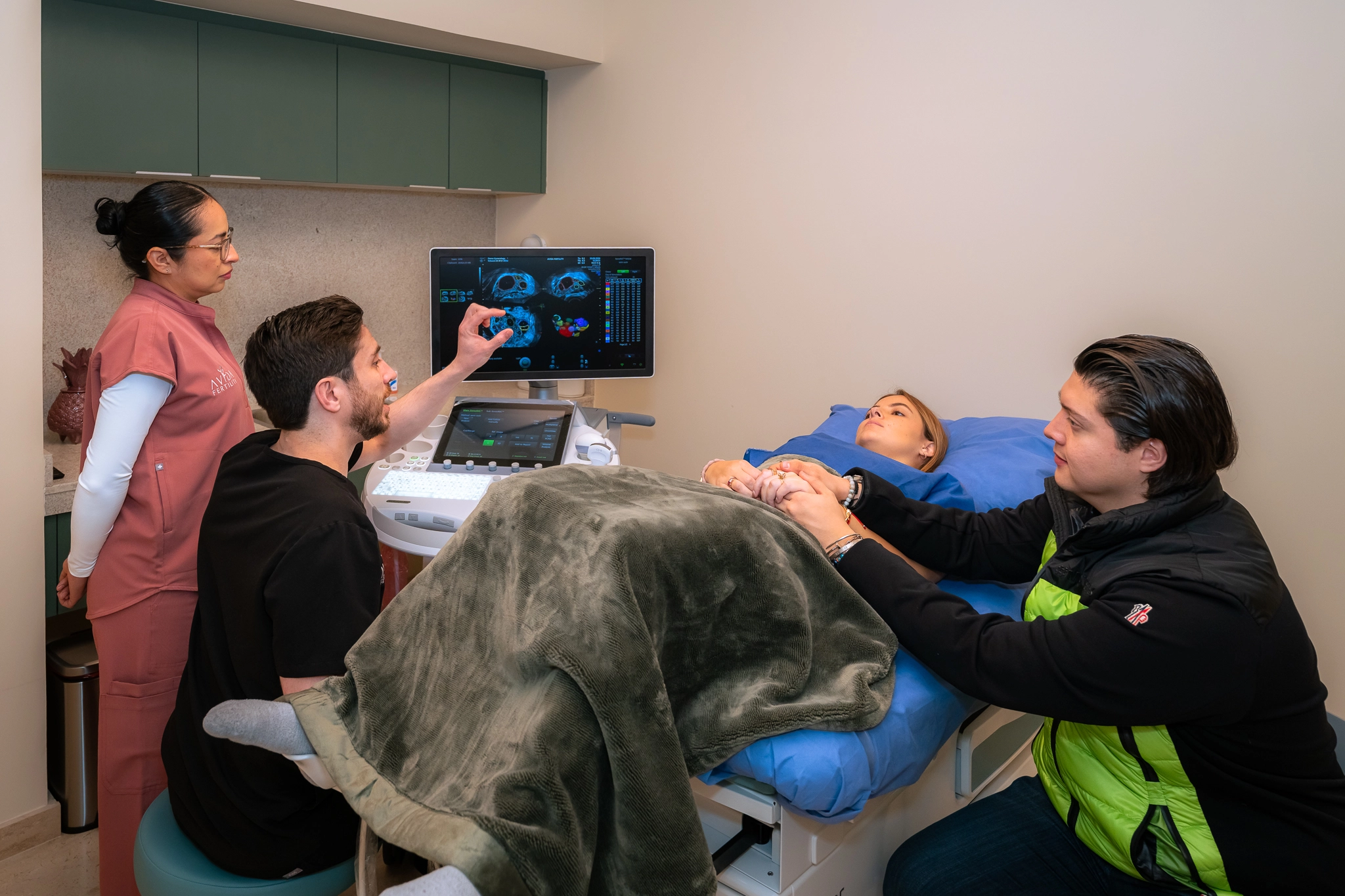
Know your starting point without pressure.
Knowing where you stand is the first step, and you set the pace. Our medical team reviews your history with you, explains what it means and walks you through your options, with full transparency and no pressure.
How Long After Implantation Bleeding Can You Take a Pregnancy Test?
Tempted to test the minute you see spotting? A test then is often negative because hCG, the pregnancy hormone, is still low. The most reliable result comes after a missed period.
hCG is made only after implantation and keeps rising, almost doubling every three days, according to MedlinePlus. Because of that, how long after implantation bleeding you can test really depends on hCG: a test taken too early may simply miss it.
Mayo Clinic says tests are more likely to be accurate after the first day of a missed period, and the FDA suggests waiting 1 to 2 weeks after a missed period, because 10 to 20 of every 100 pregnant women won't get a positive on the first day.
A negative this early isn't the final word. Retest in a few days to a week, and call your provider if two tests are negative and you still think you're pregnant. Using your first morning urine helps, because it's the most concentrated, according to Mayo Clinic and MedlinePlus.
Once the bleeding has stopped, how many days after implantation bleeding you can test matters less than a late period: wait until it's overdue.
Implantation Bleeding After an Embryo Transfer (IVF and FET)
Light spotting can happen after a transfer, but it doesn't tell you whether the cycle worked. If you're asking, "Did it work?" take a breath.
Placement of the catheter (the thin tube that places the embryo) can also be followed by light spotting, according to the American Society for Reproductive Medicine (ASRM), so implantation bleeding after an embryo transfer is possible, but it isn't a reliable sign either way.
After a transfer, fresh or frozen, the date is known, so your clinic will tell you when to test. We cover the wait in what to expect after an embryo transfer.
At Avida, the beta hCG blood test, which measures the pregnancy hormone, is done 10 to 12 days after the transfer, after in vitro fertilization (IVF), where eggs and sperm are combined in a lab, or a frozen embryo transfer (FET), which uses embryos frozen earlier.
This applies to your own eggs, donor eggs or donor sperm, alone or with a partner.
Please tell your clinic the same day if you have heavy or period-like bleeding, or a fever. Severe pain, dizziness or fainting need emergency care, so call 911 or go to the ER.
If your cycle included ovarian stimulation (medication that helps your ovaries produce eggs), keep an eye out for ovarian hyperstimulation syndrome (OHSS), which happens when the ovaries react too strongly. Most cases are mild.
Trouble breathing, leg pain, rapid weight gain (more than 2.2 pounds in 24 hours) or severe belly pain point to severe OHSS, per Mayo Clinic, so call your clinic right away.
Our medical team can explain what to expect in your own case.
What Else Can Cause Spotting Before Your Period?
Not every bit of spotting is implantation: many things can cause spotting before your period, so telling spotting from implantation bleeding takes more than color and amount.
An early or light period, hormonal "breakthrough" bleeding, irritation of the cervix (the opening of your uterus) after sex or an exam, infections and, less often, an early pregnancy loss or an ectopic pregnancy (an embryo implanting outside the uterus) can all look similar.
PMS can look similar too (see cramps above). If your cycles are irregular or you've been trying for a while, female fertility tests can help you look for patterns.
Spotting after sex deserves its own look.
Light Spotting After Sex: Could You Be Pregnant?
It can happen: you notice light spotting after sex and wonder whether you could be pregnant. It's possible, but spotting isn't a pregnancy sign by itself. In early pregnancy it can come from a friable cervix, which just means one that bleeds easily, especially after sex or a pelvic exam.
Essentia Health says this isn't a cause for concern, and Cleveland Clinic calls it a nonserious cause. Infections can do it too, so mention it to your doctor if it keeps happening.
When Should You Call a Doctor About Implantation Bleeding?
Heavy bleeding, strong or one-sided pain, shoulder pain, fainting or fever need prompt care. Most spotting is harmless, but when is it more than that? These levels apply during treatment too.
Call 911 or go to the ER right away if you have:
- Bleeding that soaks through more than one pad or tampon every hour or two.
- Severe or one-sided abdominal or pelvic pain, or shoulder pain.
- Fainting, lightheadedness or a rapid heart rate, which can signal a ruptured ectopic pregnancy, according to the MSD Manual and Mayo Clinic.
Call your doctor the same day if you have:
- Bleeding that lasts longer than the usual two days or is getting heavier.
- Large clots or a fever.
- Bright red bleeding after a positive pregnancy test.
Tell your doctor within 48 to 72 hours if you may be pregnant and have any bleeding without those warning signs, as the MSD Manual advises.
After IVF or a transfer, and before an ultrasound confirms the pregnancy is in the uterus, call your doctor immediately if spotting comes with sharp, stabbing pain, dizziness, fainting or lower back pain.
Ectopic pregnancy is uncommon with IVF, about 1% according to ASRM, but know the signs.
Bleeding that starts after your period is already late is less typical of implantation, so take a test and call your doctor.
MedlinePlus says to report any bleeding in pregnancy, so note timing, color, amount and any pain.
Care that starts by listening to you.
We know every story is different and that taking the first step takes courage. Our medical team takes the time to assess your overall health and walk you through your options step by step, in a safe space and with complete transparency.
Implantation Bleeding in Summary
Light pink or brown spotting that lasts a few hours to two days and shows up roughly 6 to 14 days after ovulation is typical of implantation bleeding, and it's lighter and shorter than a period.
A test during spotting is often negative, so wait until your period is late and repeat if needed.
Heavy bleeding, strong or one-sided pain, shoulder pain, fainting or fever need prompt care. And you don't have to wait this out alone: your doctor or clinic can answer your questions at your own pace.
Book your assessment
References
- American Society for Reproductive Medicine. (2023). In vitro fertilization (IVF): What are the risks?. https://www.reproductivefacts.org/news-and-publications/fact-sheets-and-infographics/in-vitro-fertilization-ivf-what-are-the-risks/. Accessed November 1, 2026.
- Cleveland Clinic. (2024, August 9). Implantation bleeding: Causes, symptoms & what to expect. https://my.clevelandclinic.org/health/symptoms/24536-implantation-bleeding. Accessed November 1, 2026.
- Cleveland Clinic. (2025, September 23). Period blood comes in different colors: Here's what they mean. https://health.clevelandclinic.org/what-does-the-color-of-your-period-mean. Accessed November 1, 2026.
- Essentia Health. (2025, December 30). Implantation bleeding vs. your period: How to tell the difference. https://www.essentiahealth.org/about/essentia-health-newsroom/obgyn-implantation-bleeding-vs-your-period-how-to-tell-the-difference. Accessed November 1, 2026.
- Food and Drug Administration. (2019, April 29). Pregnancy. https://www.fda.gov/medical-devices/home-use-tests/pregnancy. Accessed November 1, 2026.
- Mayo Clinic. (2021, November 9). Ovarian hyperstimulation syndrome: Symptoms and causes. https://www.mayoclinic.org/diseases-conditions/ovarian-hyperstimulation-syndrome/symptoms-causes/syc-20354697. Accessed November 1, 2026.
- Mayo Clinic. (2022, March 12). Ectopic pregnancy: Symptoms and causes. https://www.mayoclinic.org/diseases-conditions/ectopic-pregnancy/symptoms-causes/syc-20372088. Accessed November 1, 2026.
- Mayo Clinic. (2025, March 12). Sperm: How long do they live after ejaculation?. https://www.mayoclinic.org/healthy-lifestyle/getting-pregnant/expert-answers/pregnancy/faq-20058504. Accessed November 1, 2026.
- Mayo Clinic. (2025, May 10). Implantation bleeding: Common in early pregnancy?. https://www.mayoclinic.org/healthy-lifestyle/pregnancy-week-by-week/expert-answers/implantation-bleeding/faq-20058257. Accessed November 1, 2026.
- Mayo Clinic. (2026, April 1). Home pregnancy tests: Can you trust the results?. https://www.mayoclinic.org/healthy-lifestyle/getting-pregnant/in-depth/home-pregnancy-tests/art-20047940. Accessed November 1, 2026.
- Mayo Clinic. (2026, June 3). Menstrual cycle: What's typical, what's not. https://www.mayoclinic.org/healthy-lifestyle/womens-health/in-depth/menstrual-cycle/art-20047186. Accessed November 1, 2026.
- MedlinePlus. (2025, September 25). Pregnancy test. https://medlineplus.gov/lab-tests/pregnancy-test/. Accessed November 1, 2026.
- MedlinePlus. (2026, March 17). Vaginal bleeding in pregnancy. https://medlineplus.gov/ency/article/003264.htm. Accessed November 1, 2026.
- MSD Manual Consumer Version. (2026, February). Vaginal bleeding during early pregnancy. https://www.msdmanuals.com/home/women-s-health-issues/symptoms-during-pregnancy/vaginal-bleeding-during-early-pregnancy. Accessed November 1, 2026.
- National Institute of Child Health and Human Development. (2017, January 31). What are some common signs of pregnancy?. https://www.nichd.nih.gov/health/topics/pregnancy/conditioninfo/signs. Accessed November 1, 2026.
- Planned Parenthood. (2023, April 17). How can I calculate how many weeks pregnant I am?. https://www.plannedparenthood.org/blog/how-can-i-calculate-how-many-weeks-pregnant-i-am. Accessed November 1, 2026.
- Wilcox, A. J., Baird, D. D., & Weinberg, C. R. (1999). Time of implantation of the conceptus and loss of pregnancy. New England Journal of Medicine, 340(23), 1796-1799. https://pubmed.ncbi.nlm.nih.gov/10362823/. Accessed November 1, 2026.